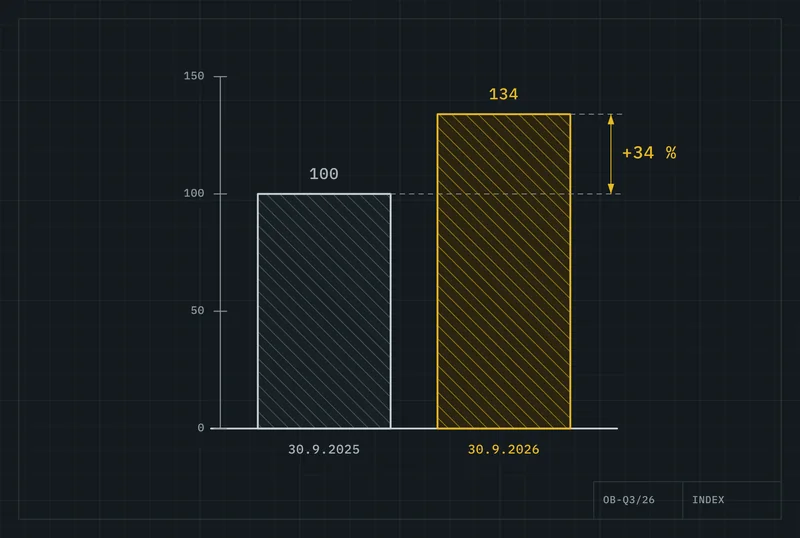
In short
New orders in Finland’s technology industry grew by 50% year on year in July–September, and the order book at the end of September was 34% larger than a year earlier. Growth came from exports: export orders rose 66%, domestic orders fell 2%. A machine shop should therefore point its sales at exporters and their main suppliers, especially in the marine, defence, energy and data-centre industries, and reserve capacity for the first half of 2027.
- New orders in July–September 2026: +50% year on year and +19% on the previous quarter.
- Export orders +66%, domestic orders −2% year on year.
- Order book on 30 September 2026: +34% in a year (exports +42%, domestic +7%).
- Machinery and metal products employed 138,200 people at the end of June, the most since the financial crisis.
- Risks: the Middle East, trade-policy tensions and inflation. Cost pressures held growth back.
What do the technology industry’s autumn figures say?
Technology Industries of Finland published its economic outlook on 4 November 2026. The value of new orders grew by 50% year on year in July–September and by 19% on April–June. The order book on 30 September 2026 was 34% larger than a year earlier and 14% larger than at the end of June. The figures exclude metals processing, game software and data centres.
Headcount in the sector turned to growth, the strongest since early 2023. The sector employed 331,100 people, and 10,100 were temporarily laid off at the end of September. The association summed it up: growth continues, but cost pressures slowed the rise compared with recent months.
| Measure | Export | Domestic | Total |
|---|---|---|---|
| New orders, change in a year | +66% | −2% | +50% |
| New orders, change on previous quarter | +37% | −32% | +19% |
| Order book 30 Sep, change in a year | +42% | +7% | +34% |
| Order book, change 30 Jun–30 Sep 2026 | +19% | −2% | +14% |
Why are domestic orders not growing?
The figures do not break down the reasons. According to the association, purchasing managers’ indices point to growth in key export markets, and euro-area industry and services are still expanding. Domestic orders, by contrast, are at last year’s level. Compared with the previous quarter they fell 32%, but one quarter’s swing should not be over-read.
Ironspan’s reading is that selling directly to a domestic end user is now harder than selling into an exporter’s supply chain. An exporter’s order book turns into production with a lag of months. That is when parts, sub-assemblies and extra capacity are needed, and the need shows first in the main suppliers’ purchasing.
Which industries are driving growth?
According to the association, the marine industry drove new orders most in the third quarter. In August it named the marine industry, defence, data-centre investment and energy solutions as sources of growth. At the end of June the balance of requests for quotation stood at +20, the highest since late 2021.
For a machine shop these industries mean work such as:
- Marine: welded structures, piping parts and outfitting parts.
- Defence: machined and welded parts with strict documentation and traceability.
- Energy and grids: enclosures, frames and brackets.
- Data centres: racks, sheet-metal parts and cooling-system parts.
What should a machine shop do before 2027?
- List the exporters. Collect the exporters in your area and their main suppliers in the industries above. Start with those whose parts suit your current machines.
- Find out what they buy in. Processes, materials, batch sizes and certificates. When you know the need before the request for quotation, the conversation starts on the buyer’s terms.
- Describe capacity in the buyer’s language. Machines, working envelopes, tolerances and free machine time in weeks. A capacity review produces this kind of card.
- Reserve capacity for early 2027. When order books turn into production, lead time is often the deciding factor.
- Check your pricing. Cost pressures held growth back. Separate material and work in quotes so that a price review only touches what changes (steel tariffs and CBAM).
- Start with a defined delivery. New buyers often approve a supplier through a trial order (becoming a second-source supplier).
Which risks could change the picture?
The association points to geopolitical shocks, an escalation in the Middle East, trade-policy tensions and rising inflation. In October the IMF forecast euro-area growth of 1.1% in 2026 and 1.2% in 2027. The economy is growing moderately. In Ironspan’s reading, the exceptionally strong order figures say more about a few leading industries than about the economy as a whole.
Frequently asked questions
How much did technology industry orders grow in autumn 2026?
The value of new orders grew by 50% year on year in July–September and by 19% on the previous quarter. The order book at the end of September was 34% larger than a year earlier (Technology Industries of Finland, 4 Nov 2026).
Why are exports growing but domestic orders not?
The figures do not break down the reasons. According to the association, purchasing managers’ indices in key export markets point to growth, while domestic orders are at last year’s level.
Which industries are increasing orders?
In the third quarter, the marine industry most of all. The association has also named defence, data-centre investment and energy solutions as sources of growth.
How does a machine shop become an exporter’s supplier?
Find out what the company buys in, describe your capacity in the buyer’s language and offer a defined trial order through which delivery reliability and quality can be shown.
How many people work in Finland’s machinery and metal products industry?
138,200 at the end of June 2026, the most since the financial crisis (Technology Industries of Finland, 5 Aug 2026).
Let’s find the exporters whose parts suit your machines
Ironspan maps a machine shop’s capability, finds buyers in the leading industries and opens the conversation. The shop prices, quotes and delivers itself. Commission only on completed orders.
Sources
- Teknologiateollisuus: Talousnäkymät 4/2026 (esitysaineisto) (4.11.2026)
- Teknologiateollisuus / STT Info: Kolmannen neljänneksen talousnäkymät (29.10. ja 4.11.2026)
- Teknologiateollisuus / STT Info: Kone- ja metallituoteteollisuuden henkilöstömäärä palasi korkeimmalle tasolleen finanssikriisin jälkeen (5.8.2026)
Published 6 November 2026. Updated 13 November 2026.