In short
For most Finnish machine shops the change is indirect: it shows in the price and availability of imported steel and in paperwork. Put a validity period or a price review clause for material in your quotes, ask your steel supplier for the mill certificate and melt country, and tell buyers where the material comes from. A direct CBAM obligation only arises if you import CBAM goods from outside the EU yourself, above 50 tonnes a year.
- 1 July 2026: Regulation (EU) 2026/1384 replaced the steel safeguard. Tariff-free quotas total 18,345,922 tonnes a year, on average 47% less than before, and the out-of-quota duty is 50%.
- 1 October 2026: importers must provide verifiable evidence of the country where the steel was melted and poured, such as a mill certificate.
- CBAM: the paying phase began on 1 January 2026. Imports below 50 tonnes a year are exempt, and 2026 imports must be declared by 30 September 2027.
- Downstream goods: extending CBAM to steel and aluminium downstream products from 1 January 2028 is under negotiation. The first trilogue on 20 October 2026 ended without a deal.
What changed in EU steel imports on 1 July 2026?
The steel safeguard expired on 30 June 2026 and was replaced by the permanent Regulation (EU) 2026/1384. It covers 26 steel product categories. Tariff-free import quotas total 18,345,922 tonnes a year: half for the EU’s free trade partners and half for other countries. Compared with the safeguard, duty-free volumes were cut by 47% on average.
Once a quota is used up, or if a product has no quota, the duty is 50% of the value, up from 25%. If anti-dumping or countervailing duties also apply, the 50% comes on top.
The scope may still grow. By 31 December 2026 the Commission will assess whether to add currently excluded CN codes, and by 30 June 2027 whether the regime should also cover downstream products containing a lot of steel.
What does the melt-and-pour requirement mean for a machine shop?
From October 2026, importers must show the country where the steel was melted and poured, for example with a mill certificate. From October 2027 the melt country starts to inform quota distribution, and by June 2028 the Commission will assess whether it should become the main basis for quota access.
The obligation is on the importer. If you buy steel from a Finnish stockholder, they handle customs. You may still see the change in three ways: prices of imported grades can rise as quotas fill, some grades or sizes may need longer lead times, and buyers start asking where the material comes from.
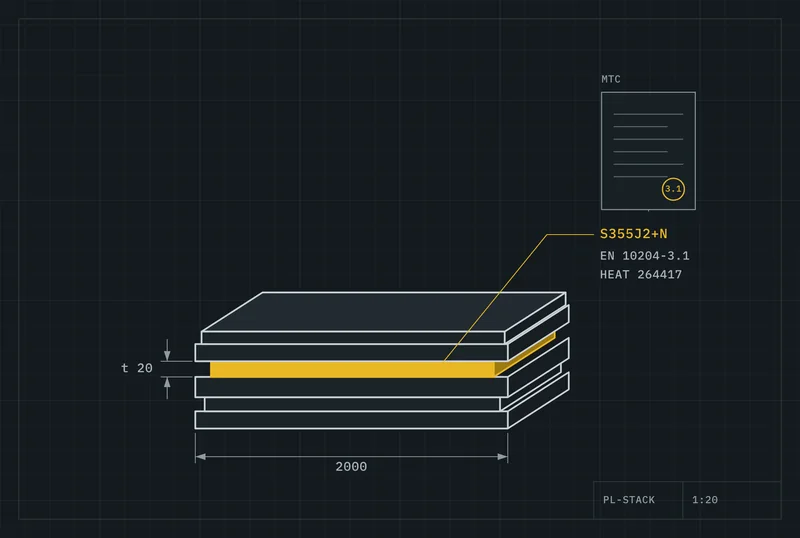
The practical step is simple. Ask your supplier for a mill certificate to EN 10204, usually type 3.1, and keep it with the batch. It shows the steel mill and heat number. If the melt country is not stated, ask the supplier for it separately.
Does CBAM apply to a machine shop?
CBAM, the EU carbon border adjustment mechanism, entered its paying phase on 1 January 2026. For iron and steel it covers chapter 72 goods and chapter 73 headings such as 7308 (structures and parts of structures), 7318 (screws, bolts and nuts) and 7326 (other articles of iron or steel) when they are imported from outside the EU.
An importer whose CBAM imports exceed 50 tonnes a year needs authorised CBAM declarant status. Emissions embedded in 2026 imports must be declared by 30 September 2027. Sales of CBAM certificates start on 1 February 2027, and for 2026 the certificate price follows the quarterly average of EU allowance auction prices. The price for the third quarter of 2026 was €82.32 per tonne of CO₂.
For most machine shops CBAM is not a direct obligation, because the steel is bought inside the EU. It matters on the buyer’s side: a buyer that imports welded structures (7308) or other steel articles (7326) from outside the EU and exceeds the 50-tonne threshold already reports and pays CBAM.
What would extending CBAM to downstream goods change?
On 17 December 2025 the Commission proposed extending CBAM to about 180 steel and aluminium downstream products from 1 January 2028. In June the Council widened the list to about 200 products and in September Parliament to about 457 product types. The first trilogue on 20 October 2026 ended without a deal, and the next round is on 30 November 2026.
The product list has not been decided, so do not promise buyers specific effects. If a broad extension is adopted, reporting on downstream goods imported from outside the EU will grow and a part made in the EU gains one more argument in a comparison.
What should you write into a quote now?
- Validity of the material price. State how long the material price holds, or tie it to the supplier’s price on the day or an agreed price index.
- Material as its own line. With material and work separated, a price review only touches the part that changes, not the whole quote.
- Origin and certificates. Say where the material comes from and which level of certificate you supply, for example EN 10204 3.1.
- Material lead time. If a grade or size is imported, confirm its lead time before you promise a completion date.
- Price review in long agreements. In an annual agreement, set out how the price is reviewed if duties or quotas change during the term. The current quota distribution act ends on 31 December 2026.
How should you talk to buyers about the changes?
Fear does not sell. It is more useful to give the facts: where the part is made, where the material comes from, which certificates you supply and how quickly a batch is available. If a buyer currently imports parts from outside the EU, ask how duties, quotas and CBAM reporting show up in their purchasing, and offer a comparison only for items where you really have capacity.
| Date | What happens |
|---|---|
| 1 Jan 2026 | CBAM paying phase began. |
| 1 Jul 2026 | Regulation (EU) 2026/1384 applies; 50% duty on out-of-quota imports. |
| 1 Oct 2026 | Importers must show the melt-and-pour country. |
| 20 Oct 2026 | First trilogue on the CBAM extension, no deal. |
| 30 Nov 2026 | Next negotiation round on the CBAM extension. |
| 31 Dec 2026 | Current quota distribution act ends; Commission assessment of extra CN codes. |
| 1 Feb 2027 | CBAM certificate sales start. |
| 30 Jun 2027 | Commission assessment of bringing downstream products into the steel regime. |
| 30 Sep 2027 | First annual CBAM declaration, for 2026 imports. |
| 1 Jan 2028 | Proposed start of the CBAM extension to downstream goods. |
Frequently asked questions
Will steel prices in Finland rise because of the new duty?
The duty applies to steel imported from outside the EU once a quota is used up. It does not apply directly to steel made in the EU, but dearer imports can affect prices across the market. Ask your supplier for price trends by grade before long agreements.
Does a machine shop need to register as a CBAM declarant?
Only if you import CBAM goods from outside the EU yourself, above 50 tonnes a year. Steel bought inside the EU creates no CBAM obligation.
What is the melt-and-pour country?
The country where the steel was melted and cast. It can differ from the country where the steel was later rolled or processed. The EU uses it to stop quotas being circumvented.
Do the steel duties apply to machined parts?
The regime covers 26 categories of basic steel products. A finished machined part is usually classified under another heading, so check your own customs code. By 30 June 2027 the Commission will assess extending the rules to downstream goods. CBAM already covers some finished steel articles, such as headings 7308, 7318 and 7326.
What should a quote say about material origin?
State the material supplier or country of origin, the certificate level and whether the material is in stock or must be ordered. Do not promise an origin you cannot prove on paper.
Let’s find buyers for whom local manufacturing is an advantage
Ironspan maps a machine shop’s capability and finds buyers whose parts suit its machines, including buyers now weighing the total cost of parts imported from outside the EU. The shop prices, quotes and delivers itself.
Sources
- Crowell & Moring: EU Steel Overcapacity Regulation – new permanent measure in force from 1 July 2026 (2026)
- ICAP: EU CBAM enters compliance phase and outlines path ahead (19.1.2026)
- Linklaters: EU CBAM simplification – what has changed for importers (27.10.2025)
- CBAM Guide: First trilogue on the CBAM downstream extension – no deal, four open issues (23.10.2026)
- CBAM Guide: CBAM steel CN codes, chapters 72 and 73 (2026)
Published 27 October 2026. Updated 13 November 2026.